For most independent agencies, the right platform is not the one with the most features. It is the one that helps your team prevent missed renewals, prioritize high-risk accounts, and move policies from upcoming to renewed without relying on spreadsheets, memory, or hallway conversations.
The Core Features Your Agency Needs
The best insurance renewal management software should include:
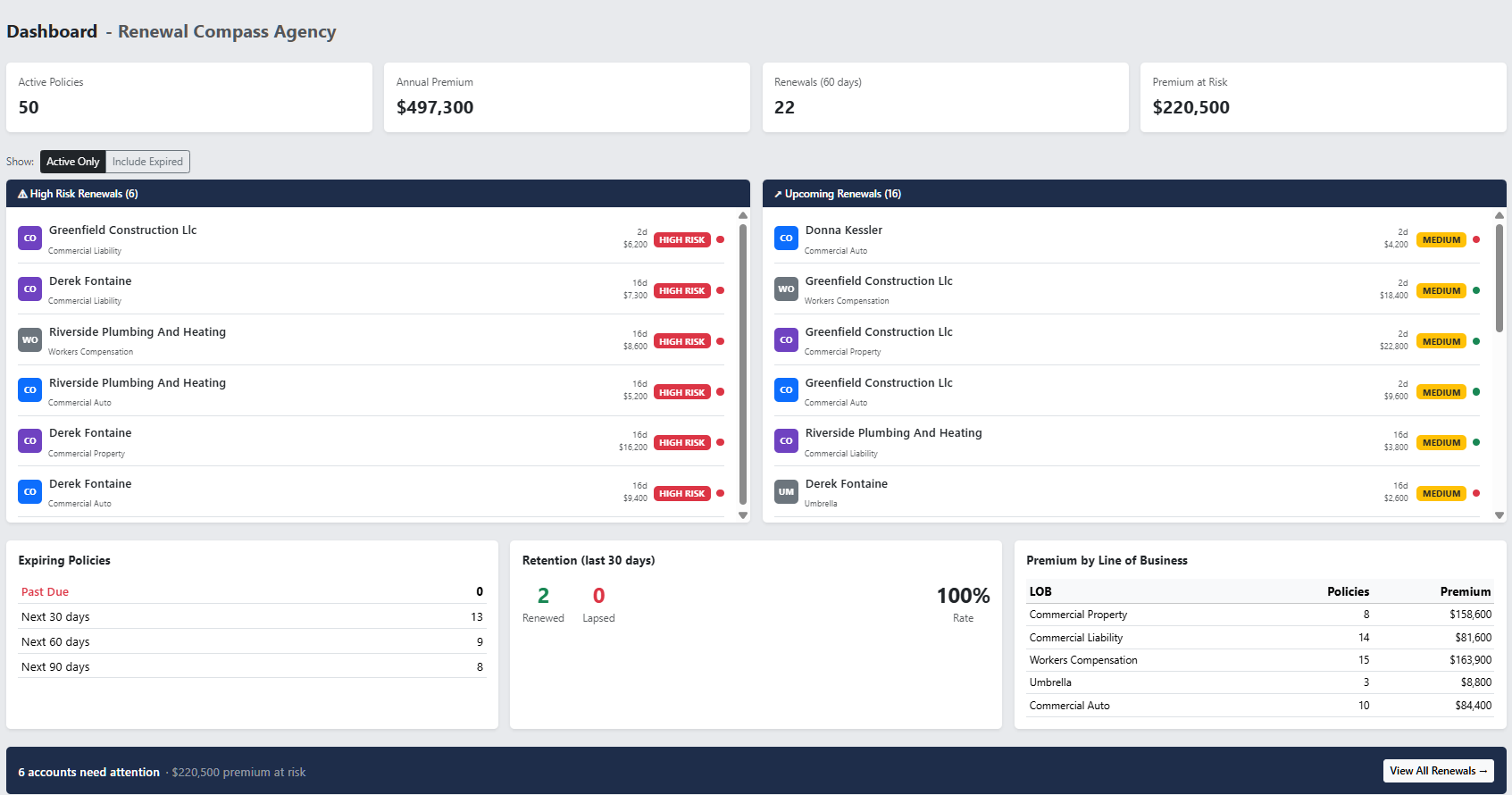
- A dashboard that shows total policies, upcoming renewals, premium at risk, and high-risk accounts
- A renewal pipeline that moves each policy through clear stages
- Automated risk scoring so your team knows what to work first
- Renewal alerts tied to policy expiration dates
- Contact tracking so no account goes quiet
- A renewal calendar for the next 30, 60, and 90 days
- CSV import for agencies migrating from spreadsheets or an AMS export
- Clean carrier and policy data management
- Team workflows with visibility across producers and staff
- Client meeting reports that summarize policies, activity, and notes
If a system cannot do those things well, it is probably not renewal management software. It is just a database with a reminder feature.
Why This Matters for Independent Agencies
Independent insurance agencies rarely lose renewals because someone stopped caring. More often, they lose them because the process is fragmented.
A producer has the relationship. A CSR has part of the servicing history. The expiration date lives in one system. Notes live somewhere else. Outreach happens by phone or email, but there is no clean way to see whether the account is actually moving toward renewal.
That is the gap renewal management software is supposed to close.
1. A Book Overview Dashboard
Your team should be able to open one screen and immediately answer four questions:
- How many policies are active?
- What is renewing soon?
- How much premium is at risk?
- Which accounts need attention first?
This matters because renewal work is operational before it is relational. If the book is not visible, the team is reacting instead of managing.
Good dashboard metrics include:
- Total policies
- Renewals in the next 30, 60, or 90 days
- Premium at risk
- High-risk renewals
- Filters by producer, carrier, or line of business
2. A Clear Renewal Pipeline
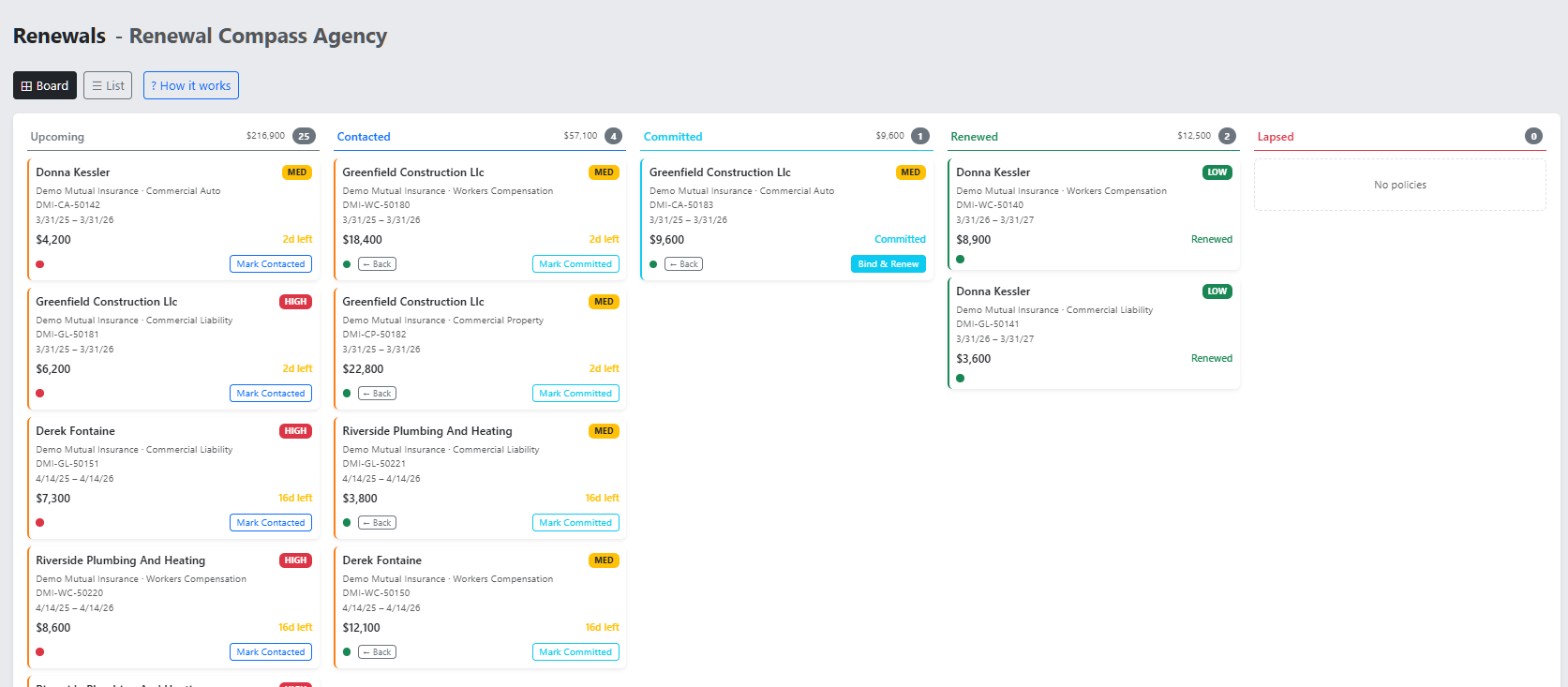
A renewal pipeline gives every policy a visible stage. That sounds simple, but it changes how agencies work.
Instead of asking "Did anyone reach out to this account yet?" your team can see whether a policy is:
- Upcoming: expiring within the window, no outreach logged
- Contacted: outreach has been made, follow-up may be scheduled
- Committed: client has agreed to renew
- Renewed: new policy term has been created
- Lapsed: policy expired without renewal
The value is not just organization. The value is operational clarity. Everyone knows what stage the policy is in and what action should happen next.
The best systems make stage progression simple. If the workflow requires too many clicks, people stop updating it.
3. Automated Risk Scoring
Not every upcoming renewal deserves the same level of attention.
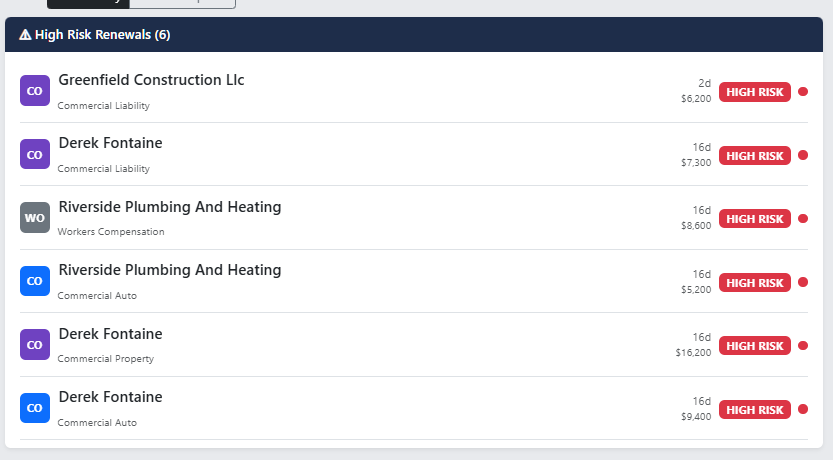
The policies most likely to create problems are usually the ones with a mix of timing pressure, premium exposure, weak recent contact, or claim activity. Good renewal software surfaces those accounts automatically instead of forcing a producer or manager to hunt for them manually.
A practical risk model looks at:
- Days to expiration: the closer the date, the higher the urgency
- Premium size: larger accounts carry more revenue risk
- Days since last producer contact: accounts that have gone quiet are flagged higher
This matters because a 14-day countdown on a large account with no recent contact is not the same risk as a low-premium policy that was touched yesterday.
4. Renewal Alerts and a Forward-Looking Calendar
A renewal process breaks down when it depends on memory.
Renewal management software should automatically flag what is coming at 90, 60, 30, and 14 days before expiration. It should also show upcoming work in a date-driven view so producers and account managers can plan ahead.
This helps agencies move from "What is on fire today?" to "What must be handled this month?"
At minimum, look for:
- Automated pre-expiration alerts
- A renewal calendar or sortable expiration view
- Priority ordering by risk or urgency
5. Contact Tracking That Is Visible on the Policy
One of the most useful features in renewal software is often one of the simplest: visible contact status.
If a policy has not been touched recently, the system should make that obvious. A producer should not need to open multiple records to figure out whether outreach happened.
Useful contact tracking includes:
- Logged calls, emails, and notes with timestamps
- Last-contact visibility directly on the renewal record
- Simple status indicators that show fresh versus stale outreach
- Follow-up date scheduling with automatic dashboard alerts when follow-ups are due
That visibility is what prevents quiet accounts from drifting into lapse territory.
6. Fast Policy Updates and Term Creation
Renewal tracking software should reduce clerical work, not add to it.
When a policy renews, the workflow should be straightforward: confirm the renewal and let the system create the next term with the same carrier, line of business, and premium baseline with dates advanced by one year. That removes repetitive data entry and makes the pipeline easier to maintain consistently.
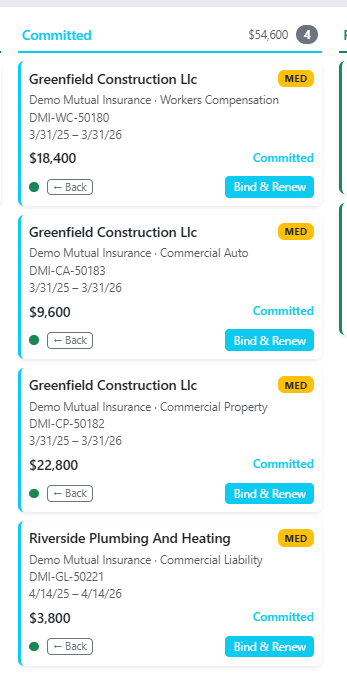
If the system makes renewal completion tedious, data quality will deteriorate over time.
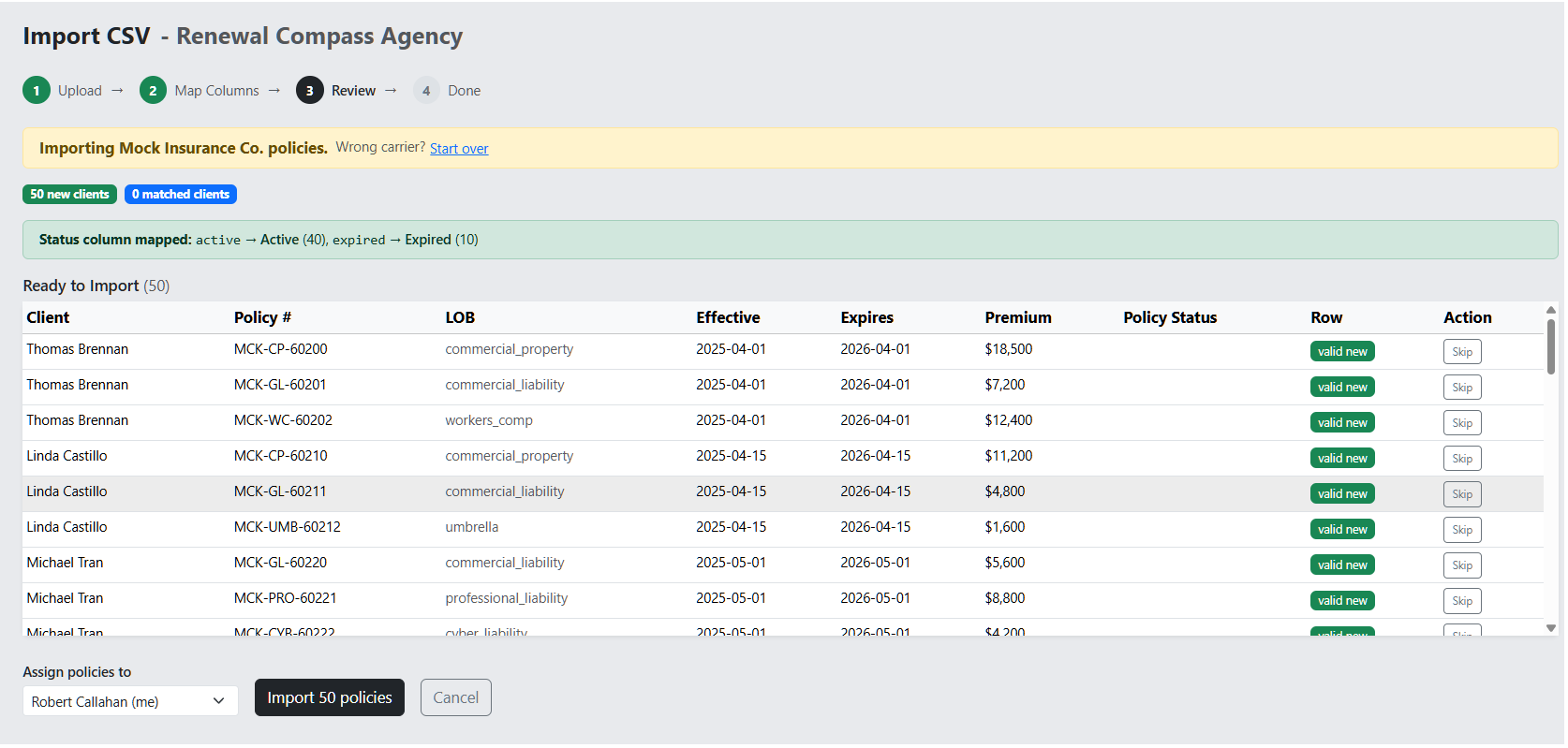
7. CSV Import for Real-World Agency Data
Many agencies start with spreadsheets, exports from an AMS, or manually maintained books of business. A renewal tool has to meet that reality.
CSV import should not be an afterthought. It should support:
- Common column matching and automatic field mapping
- A staging review before anything is committed
- Batch processing of large record sets
- Clean mapping for client, policy, carrier, dates, and premium fields
If migration is painful, adoption stalls before the team ever sees value.
8. Clean Carrier and Policy Data
Renewal reporting is only as good as the data behind it.
Structured carrier selection matters. Free-text carrier names create duplicates, reporting errors, and unreliable pipeline views. The same is true for inconsistent policy fields and line-of-business naming.
Renewal management software should help agencies standardize data as it enters the system, not force them to clean it up after the fact.
9. Team Visibility Across the Agency
Renewals are rarely owned by one person from start to finish.
The best systems make it easy for producers, CSRs, and leadership to see the same book, understand current status, and step in when needed. That visibility matters even more when an agency is growing, because informal knowledge stops scaling long before the book does.
At minimum, teams need:
- Shared visibility into renewal status across the whole book
- Clear ownership by producer or account manager
- Access controls appropriate for each role
- A way to filter or switch between producer books
- An activity log that shows what the whole team has done
10. Client Meeting Reports
A renewal conversation is stronger when the producer walks in prepared.
Good renewal software should generate a client-ready summary that pulls together:
- All active policies
- Carriers and premium totals
- Expiration dates
- Renewal status
- Logged activity and notes
That turns scattered servicing history into a usable meeting prep document.
What Renewal Management Software Should Not Be
It should not be:
- A spreadsheet with color-coding
- A generic CRM adapted awkwardly for policy renewals
- A full AMS implementation when your actual problem is renewal visibility
- A reminder system with no workflow behind it
If a tool cannot show the book, rank risk, track contact, and move policies through a renewal pipeline, it will not solve the actual operational problem.
Frequently Asked Questions
What is insurance renewal management software?
Insurance renewal management software is a system that helps agencies track expiring policies, prioritize at-risk accounts, log outreach, and move each policy through a structured renewal workflow until it is renewed or lapsed.
How is renewal management software different from an AMS?
An agency management system handles a wide range of operational tasks across the full policy lifecycle. Renewal management software is narrower. It focuses specifically on renewal visibility, workflow, prioritization, and follow-through. Agencies often use both, or choose renewal software when their primary need is retention rather than full policy administration.
What is the most important feature in renewal software?
The most important feature is a clear renewal workflow that every team member can actually use. Without that, alerts, dashboards, and reports become reference material instead of operational tools.
Can a small independent agency use renewal software without a full AMS migration?
Yes. Many agencies start with CSV imports, spreadsheet-based books, or limited exports from their existing systems. Good renewal software should make that transition straightforward without requiring a system-wide migration.
What should agencies measure in a renewal dashboard?
Agencies should track total policies, upcoming renewals by time window, premium at risk, high-risk account count, recent contact activity by account, and renewal stage distribution across the book.
A Practical Buying Checklist
If you are evaluating renewal management software, ask these questions before you commit:
- Can I see the full renewal book in one dashboard?
- Can every policy move through a defined renewal pipeline?
- Does the system automatically surface high-risk accounts?
- Can I see which accounts have gone too long without contact?
- Does it alert my team before expiration dates?
- Can I import data cleanly from CSV or AMS exports?
- Does it standardize carriers and policy records?
- Can producers and CSRs work from the same view?
- Can I prepare for client renewal meetings quickly?
- Does the workflow save time, or add administrative friction?
Where RenewalCompass Fits
RenewalCompass is built around those exact needs for independent insurance agencies. It combines a book overview dashboard, automated risk scoring, renewal alerts, CSV import, structured policy data, a five-stage renewal pipeline, and client meeting reports in one focused system.
For agencies that do not need a full AMS rollout just to improve renewal execution, that kind of focused design matters.
Also worth reading:
- What Is a Renewal Pipeline and Why Every Independent Agency Needs One
- How Independent Agents Track Policy Renewals (And Why Most Systems Fall Short)
- AMS Alternatives for Independent Agents Who Just Need Renewal Tracking
- From Upcoming to Renewed: How the Pipeline Board Works
- How Independent Agents Can Manage 500+ Policy Renewals Without a Full AMS
RenewalCompass covers that full list: book overview dashboard, automated risk scoring, five-stage renewal pipeline, CSV import, contact logging, renewal alerts, team access controls, and client meeting reports. Built for independent agencies, not enterprise brokerages.
Get early access and get notified the day subscriptions open. Launching Q3 2026.