There is a point in every growing independent agency where the spreadsheet stops working. Not all at once. It is gradual. A renewal slips. A follow-up falls through. A producer swears they sent a quote that nobody can find. The spreadsheet is still technically open in a browser tab somewhere, it just does not reflect reality anymore.
For most independent agents, the answer they hear is: "Get an AMS." And if a full agency management system fits your budget, your staff size, and your workflow, that is probably the right call. But a lot of independent agencies are not there yet, or have an AMS that handles policy data just fine but does nothing useful for renewal workflow. The data is in there. The renewal pipeline is not.
This post is for the agency that has outgrown spreadsheets, is not ready to commit to a full AMS implementation, or has an AMS that does not surface renewals the way you actually need to work them.
The Scale Problem at 500+ Policies
Below 100 policies, a good spreadsheet and a sharp CSR can hold things together. Above that, the cracks start to show. Above 500, the spreadsheet becomes a liability.
The problem is not the data. Most agencies have data. It lives in their AMS, in their carrier portals, in email threads, in their head. The problem is that at 500 policies, no single person can hold the full picture of what is coming due, what has been contacted, what is at risk, and what is sitting untouched with 18 days left.
A full AMS does not automatically solve this either. Most management systems are designed to store policy data, not to surface it as a working renewal pipeline. The renewal management piece is often an afterthought, or requires an add-on, or just means running a report and exporting to yet another spreadsheet.
What you actually need is a clear view of your book, organized around the renewal cycle.
Start with What Is Coming Due
The first thing a growing independent agency needs is a single dashboard that shows the whole book at a glance. Not a report you run. Not an export. A live view of every policy, every expiration date, and every renewal that needs attention.
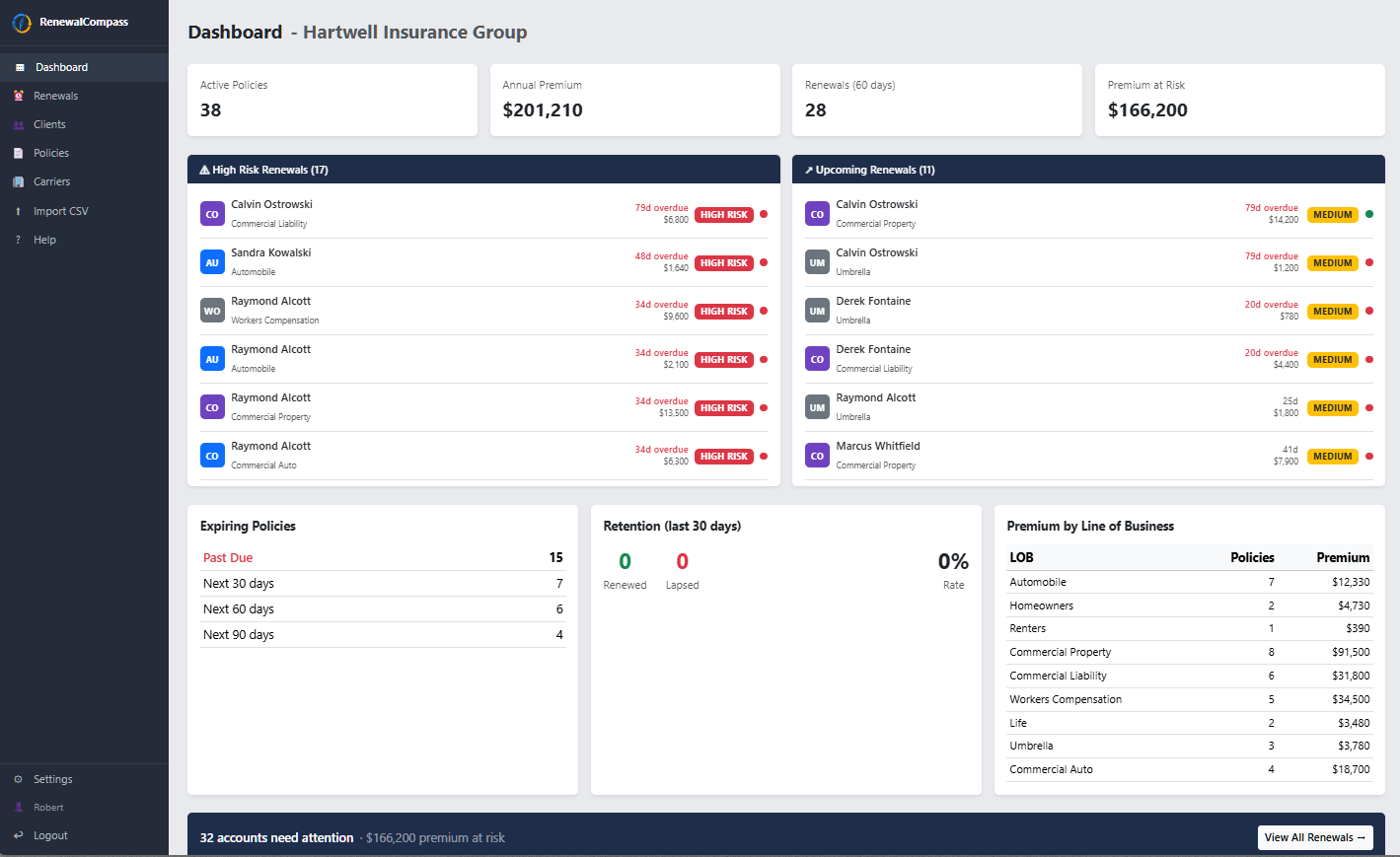
The numbers that matter at a glance are:
- Total active policies
- How many are renewing in the next 30 and 60 days
- Total premium at risk in that window
- How many of those are flagged high risk
That last one is the most important, and it is the one spreadsheets cannot tell you.
Not All Renewals Deserve Equal Attention
When you are managing 500 policies, treating every renewal the same is how things fall through. A personal auto renewing with a long-term client who has never had a claim is not the same as a commercial property with $44,000 in premium, an open claim, and no producer contact in 60 days.
Risk scoring separates these automatically. Every policy should be scored in real time based on factors like premium size, days to expiration, claim activity, and how recently a producer made contact. High-risk accounts surface to the top without anyone having to manually sort a spreadsheet.
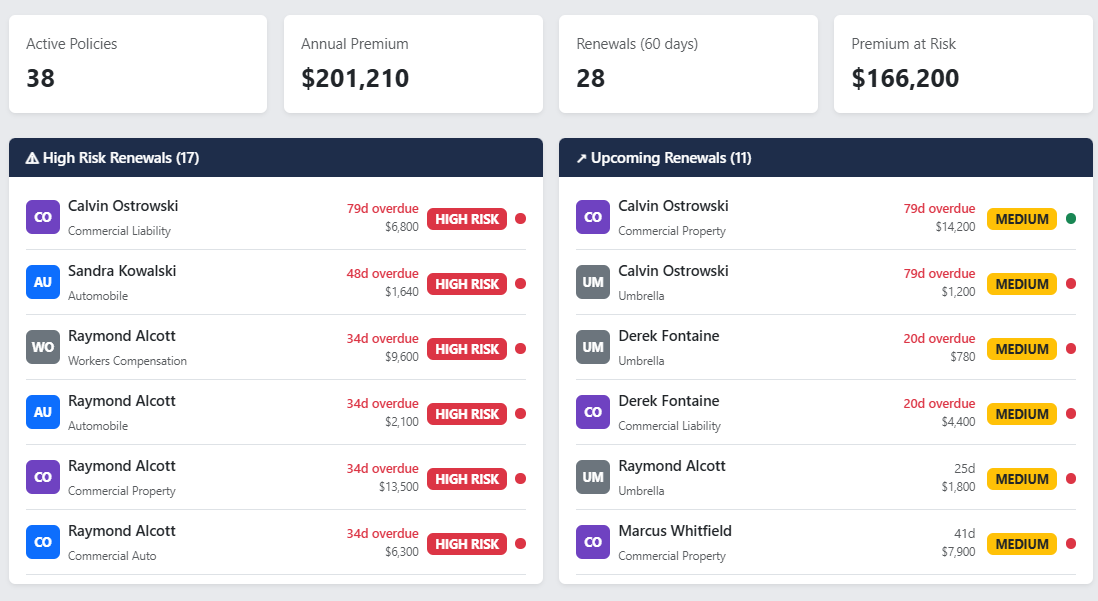
This is the difference between working your renewals in priority order and working them in expiration-date order. With 500+ policies in play, priority order is the only way to avoid spending your best attention on a $1,200 personal auto while a $38,000 commercial property sits uncontacted.
A Pipeline View, Not Just a List
Once you know what is coming due and what is at risk, you need to know where each renewal stands in your workflow. That requires a pipeline, not a list.
A renewal pipeline tracks each policy through its stages: upcoming, contacted, quoted, renewed, or lapsed. At any point, you and your team should be able to see the status of every active renewal without asking anyone or opening a spreadsheet.
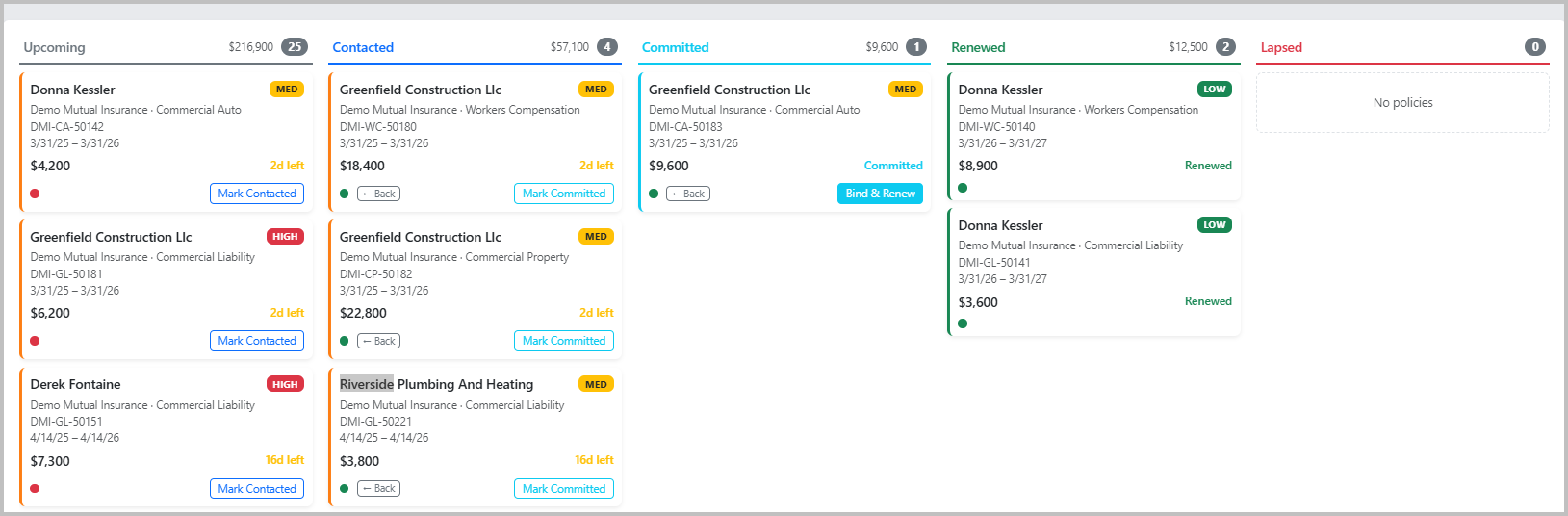
The board view is useful for a quick team standup. The list view is better for filtering and bulk review. Both should pull from the same data so nothing gets out of sync.
Getting Your Book In Without Manual Entry
The biggest reason independent agencies avoid new tools is the setup cost. Entering 500 policies by hand is not realistic. Any tool worth using should be able to accept a CSV export from whatever system you are already running.
If you are on Applied, AMS360, or even just a clean spreadsheet, the column names are different but the data is the same. A good import process maps your column headers to the right fields automatically, lets you review any mismatches, and commits records in bulk.
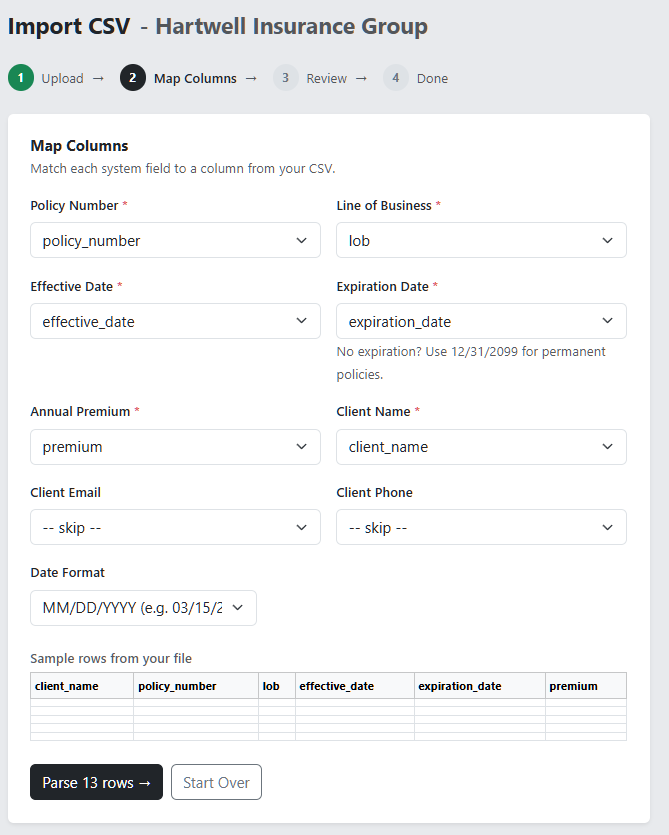
The goal is to get your book live in an afternoon, not an implementation project. Once your policies are in, the renewal pipeline builds itself from the expiration dates.
Keeping Your Team Accountable
A solo agent can hold the renewal pipeline in their head. An agency with two or three producers cannot. When multiple people are working the same book, you need to know who owns what and what has been done.
Renewal action tracking solves this. Every call, email, and meeting gets logged against the specific policy. When a producer says they contacted a client, there is a timestamped note to prove it. When you take over an account mid-renewal, you can see the full contact history without asking anyone.
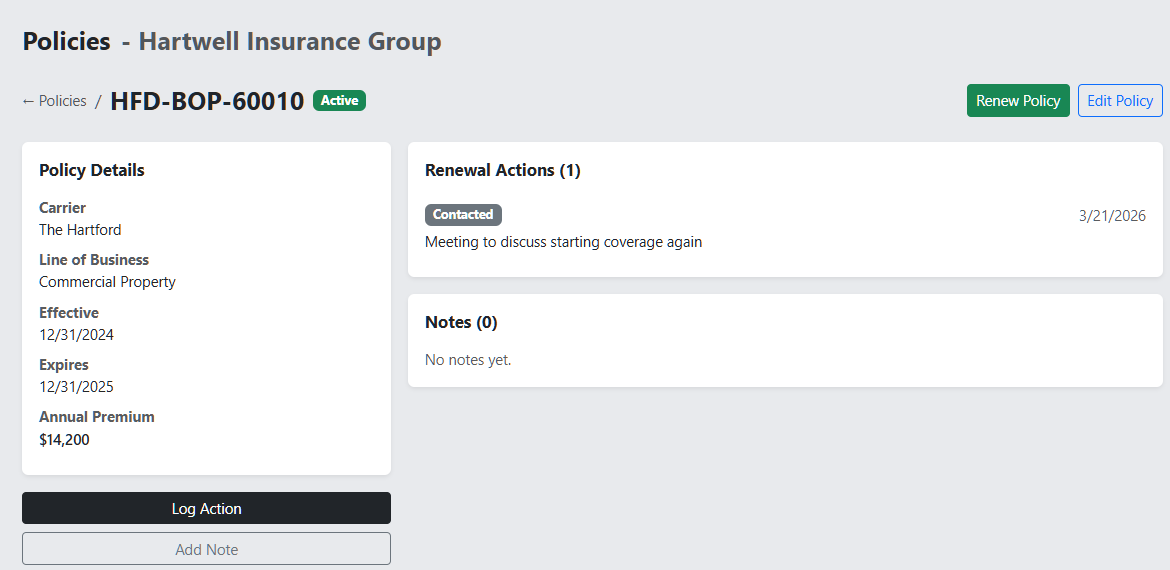
Book access controls extend this further. You can assign specific clients and policies to individual producers so each person sees their portion of the book. Admins see everything. Producers see their accounts. Nobody is working in the dark and nobody is tripping over each other.
Alerts That Work in the Background
Manual calendar reminders work until they do not. The 90-day flag you set in January is easy to miss in March when everything else is happening.
Automatic renewal alerts fire at 90, 60, 30, and 14 days before expiration without any configuration. They go to the right inbox and include enough context to act without logging in to check. The alerts do not replace the pipeline view, but they catch the things that would otherwise fall through while you are focused elsewhere.
Walking Into Renewal Meetings Prepared
With 500 policies in your book, client meetings happen regularly. Walking in without a current picture of the account is avoidable, but happens constantly when data lives in multiple places.
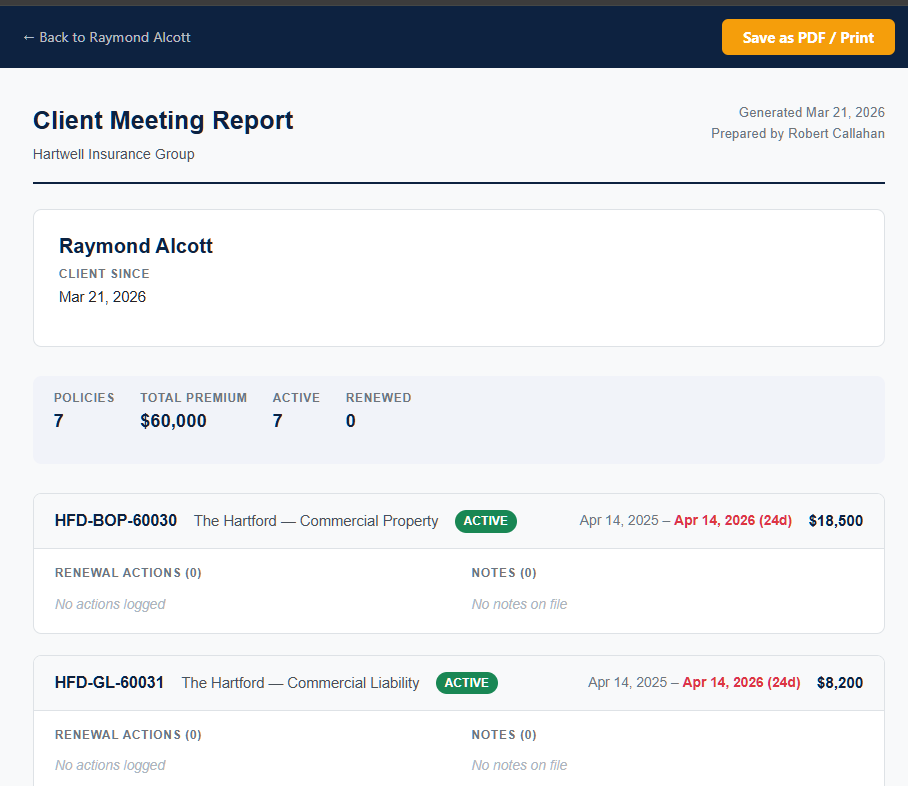
A one-click meeting report pulls every policy, every carrier, every renewal action, and every note into a single printable view. You know what is coming due, what has been done, and what still needs to happen before you sit down.
You Do Not Need an AMS to Manage a Large Book
A full agency management system is a significant investment in software, training, and process change. For some agencies it is the right move. For many independent agents managing 300 to 700 policies, the renewal problem is specific enough that a purpose-built tool handles it better than a general-purpose AMS ever would.
The goal is simple: see your whole book, know what is at risk, track what has been done, and stop losing renewals because nothing surfaced them in time. That does not require an AMS. It requires a renewal pipeline.
If you want to read more on what a renewal pipeline actually looks like in practice, we covered that in detail here.
Frequently Asked Questions
Can an agency manage 500 policies without a full AMS?
Yes, if the agency has a reliable renewal workflow. The key is having one place to see upcoming renewals, priority, ownership, and contact history instead of relying on spreadsheets and memory.
What breaks first when a book grows past 500 policies?
Usually it is visibility. The team loses track of which accounts were contacted, which ones are high risk, and which renewals need action this week.
What should an agency use instead of spreadsheets at that size?
At that point, agencies usually need software that can show the whole book, rank risk automatically, track producer actions, and keep renewal status current across the team.
Also worth reading:
- How Renewal Season Gets Away From You
- What Is a Renewal Pipeline and Why Every Independent Agency Needs One
- AMS Alternatives for Independent Agents Who Just Need Renewal Tracking
- Looking for a Zywave Alternative? Here Is What Independent Agents Use Instead.
- Why Are Independent Agents Paying to Learn Excel for Renewal Tracking?
RenewalCompass handles the renewal side of a growing book without the overhead of a full AMS. Scored risk, a shared pipeline, logged contact history, and automated alerts at the scale you need them.
Get early access and get notified the day subscriptions open. Launching Q3 2026.