If you have ever spent a morning hunting through your AMS, a spreadsheet, and your email trying to figure out which clients are renewing next month, you already know the problem. The information exists somewhere. It is just not where you need it, when you need it.
That is what a renewal pipeline solves.
What a Renewal Pipeline Actually Is
A renewal pipeline is a structured view of every policy in your book that is coming up for renewal, organized so you can see status, risk, and required action at a glance.
Think of it the way a salesperson thinks about a sales pipeline. Every deal is somewhere in a stage. You know what is close, what needs follow-up, and what is stalled. A renewal pipeline works the same way, except instead of closing new business, you are retaining existing clients.
For an independent agent or independent agency, this is the difference between working renewals reactively and getting ahead of them.
Why Most Independent Agents Do Not Have One
It is not for lack of caring. It is a tooling problem.
Most AMS platforms were designed to store data, not surface it. You can find a policy if you know where to look. But the system is not going to tell you which of your 400 accounts has a commercial auto policy expiring in 38 days with no activity logged. You have to go looking.
So agencies end up with workarounds. A spreadsheet maintained by whoever has time. A shared calendar with expiration dates. Sticky notes. A CSR who has the whole book memorized and is one vacation away from a crisis.
None of these are pipelines. They are patches.
What a Real Renewal Pipeline Looks Like for an Independent Agency
A working renewal pipeline for an independent agency has a few core elements:
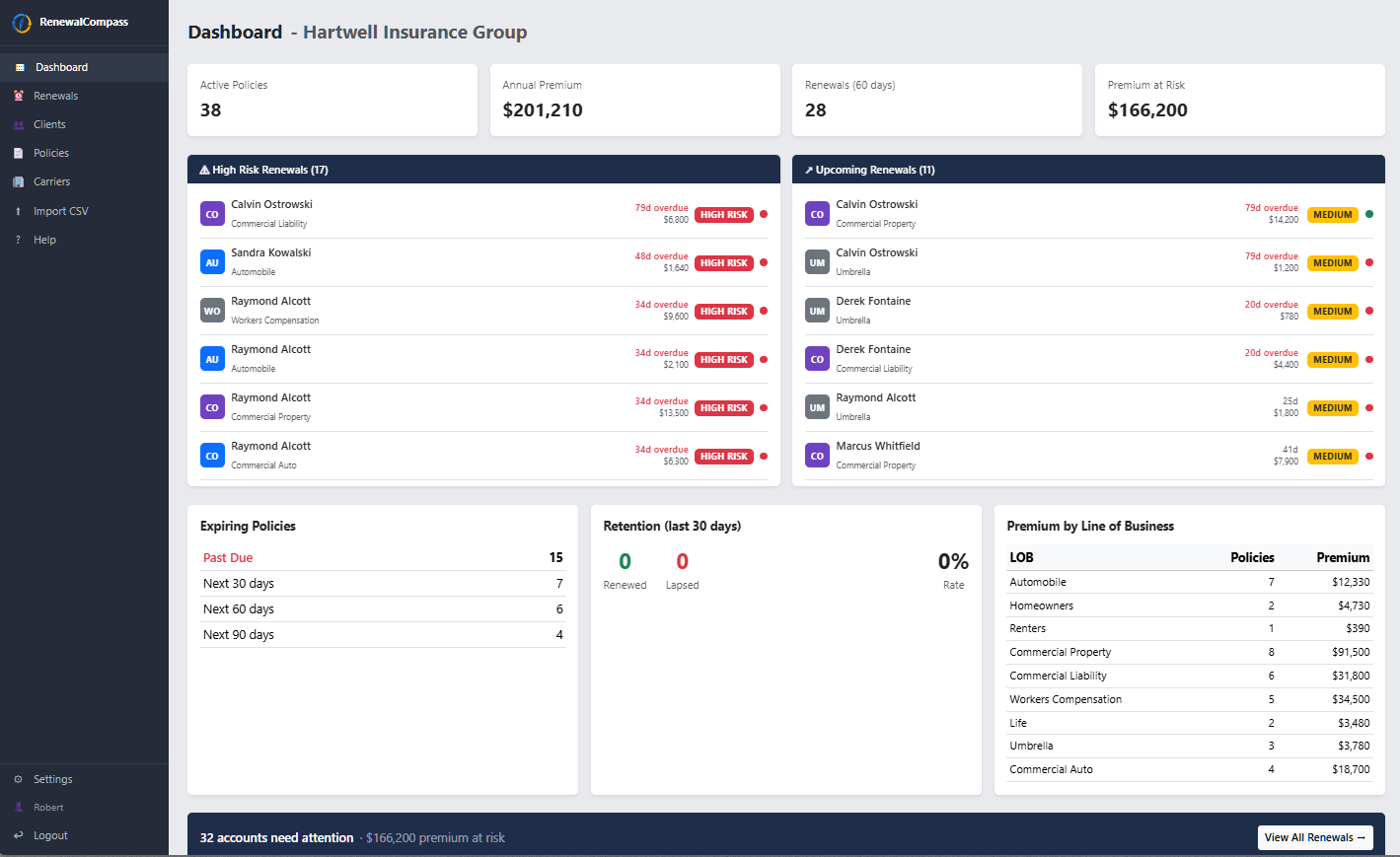
Visibility across the full book. You should be able to see every policy renewing in the next 90, 60, or 30 days without running a report or exporting anything. If you have to ask the system a question to get an answer, the pipeline is not doing its job.
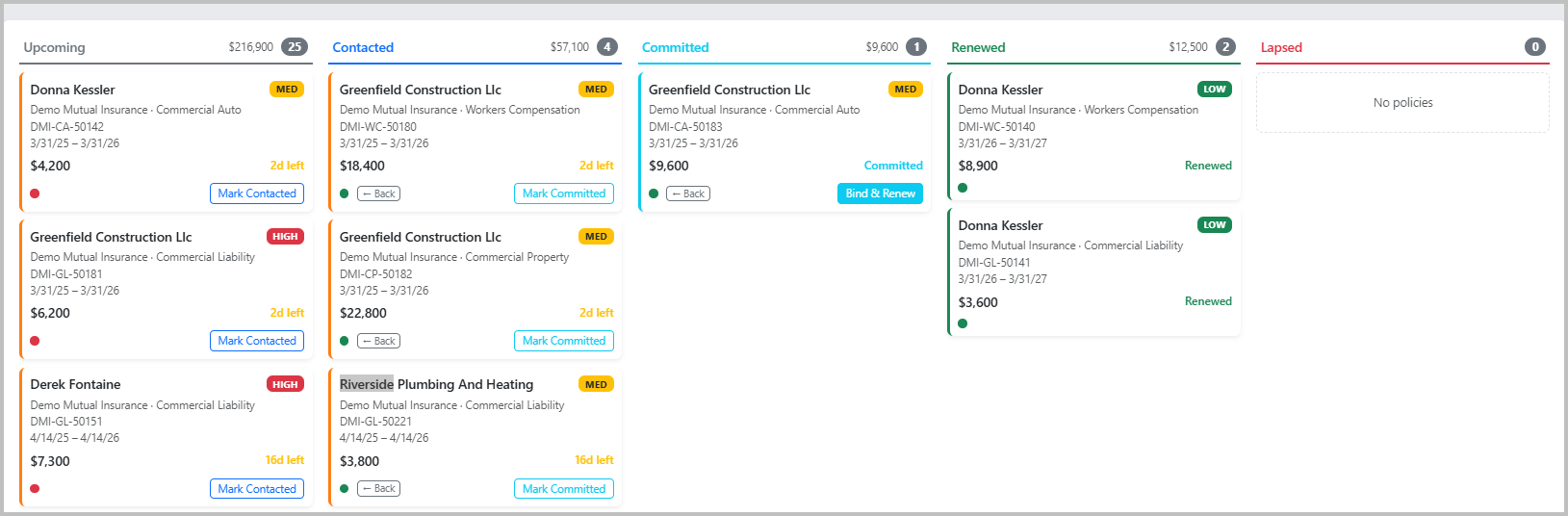
Status at a glance. Is the renewal quoted? Is the client contacted? Is there a coverage change pending? Each policy in the pipeline needs a status so you and your team know what is open and what is handled.
Risk signal. Not every renewal deserves equal attention. A long-term client with a clean account and no change in exposure is different from a new client with a complicated claim history. A renewal pipeline should help you see which accounts need more of your time.
Assigned ownership. In any agency with more than one person, someone needs to own each renewal. A pipeline without names attached is just a list.
Premium at risk. Dollar context changes how you prioritize. Knowing that a cluster of renewals next month represents $42,000 in annual premium is different from knowing you have 18 renewals due. Both matter, but the first one drives urgency in a way a count never will.
The Cost of Not Having One
Missing a renewal is the obvious risk. But it is not the most common one.
More often, the cost is the last-minute scramble. A client calls to ask about their renewal. You do not have a current quote. The underwriter needs two weeks. The policy lapses or the client shops elsewhere. Not because you did not care, but because the process did not give you enough runway.
For an independent agency competing against direct writers and national brokers, retention is the growth strategy. Losing 15% of your book every year to renewals that fell through the cracks is not a renewal problem. It is a revenue problem.
Building a Renewal Pipeline Without Starting From Scratch
You do not need a custom system or an enterprise AMS upgrade to have a functioning renewal pipeline. What you need is a way to see your upcoming renewals in one place, assign action to the right person, and know which accounts deserve your attention first.
For some agencies, a well-maintained spreadsheet can serve this function for a while. The problem is that spreadsheets require someone to keep them current, do not send reminders, and do not scale past a certain book size without becoming a liability. Once you are managing 200 or more policies, a static spreadsheet is working against you.
The better path is a purpose-built tool that keeps the pipeline current automatically, flags risk, and lets your team act on the same information in real time.
What to Do Next
If you are an independent agent or running a small independent agency, the first step is simple: build a single list of everything renewing in the next 90 days. However you do it today, do that. See what falls out. See what is missing. That gap is your renewal pipeline.
Once you can see it, you can manage it.
Frequently Asked Questions
What is a renewal pipeline in insurance?
A renewal pipeline is a structured view of upcoming policy renewals that shows status, ownership, timing, and risk. It helps agencies work renewals proactively instead of reacting at the last minute.
Why does an independent agency need a renewal pipeline?
Independent agencies need a renewal pipeline because renewal data is often scattered across an AMS, spreadsheets, calendars, and email. A pipeline brings that work into one operational view.
What should be included in a renewal pipeline?
At minimum, a renewal pipeline should show upcoming expiration dates, a status for each account, who owns the renewal, recent contact activity, and which policies are highest risk.
Also worth reading:
- From Upcoming to Renewed: How the Pipeline Board Works
- How Independent Agents Track Policy Renewals (And Why Most Systems Fall Short)
- How Renewal Season Gets Away From You
- How Independent Agents Can Manage 500+ Policy Renewals Without a Full AMS
- AMS Alternatives for Independent Agents Who Just Need Renewal Tracking
- Looking for a Zywave Alternative? Here Is What Independent Agents Use Instead.
- Why Are Independent Agents Paying to Learn Excel for Renewal Tracking?
RenewalCompass is the renewal pipeline. Every policy scored automatically, every producer action logged, every expiring account visible in one place. Built for independent agencies that are done managing renewals in a spreadsheet.
Get early access and get notified the day subscriptions open. Launching Q3 2026.